

23 Apr 2026
54m

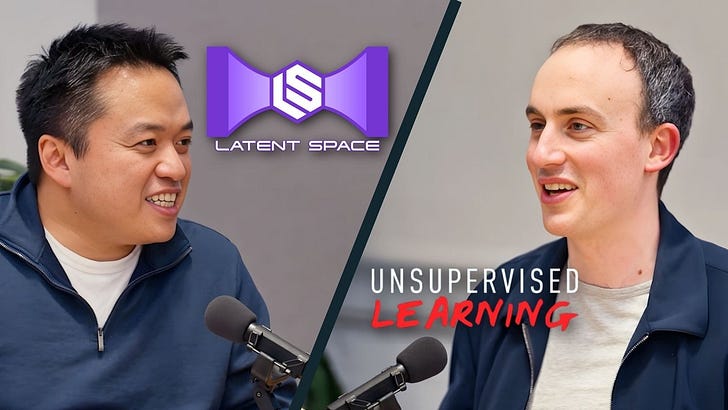
AIE Europe Debrief + Agent Labs Thesis: Unsupervised Learning x Latent Space Crossover Special (2026)

Podcast cover

Latent Space: The AI Engineer Podcast

Summary

AI coding agents are shifting from simple capability exploration to "breaking containment," with 2026 poised to see these systems expand beyond software development into broader operational roles. Swyx, host of *Latent Space*, highlights that the current market is defined by intense competition between foundation models and specialized startups, where the latter must navigate rapid infrastructure evolution. While large labs like OpenAI and Anthropic dominate, significant value remains for startups providing domain-specific "last mile" solutions. A critical emerging frontier is the "dark factory" model, where autonomous systems generate and deploy code with minimal human review, fundamentally altering the software development lifecycle. Despite the hype, memory and personalization remain the primary constraints on intelligence, necessitating a move toward sophisticated, multi-turn reinforcement learning and world models that transcend simple next-token prediction to achieve true spatial and physical understanding.

Outlines
01:21

Current AI Trends and Infrastructure Stability

The AI ecosystem is currently dominated by OpenClaw, Harness Engineering, and Context Engineering, with a persistent focus on agents and RAG. While infrastructure companies previously faced a "whack-a-mole" environment of constant change, there is emerging consensus around standard tooling, such as skills-based agent formats. Despite this, the debate between vertical and horizontal AI startups continues. Vertical companies act as outsourced AI teams, providing a robust translation layer between model capabilities and end customers, while horizontal companies are primarily reinventing cloud compute through sandboxes.

06:38

In-house Model Training and Hardware Evolution

The "agent lab" playbook involves bootstrapping on state-of-the-art foundation models before training domain-specific models to optimize for cost, latency, and performance. While marketing benefits exist, there is real value in distilling general-purpose models into smaller, specialized ones for high-volume, low-variance workloads. Furthermore, the rise of alternative hardware, such as Cerebras and Thales, is drastically increasing inference speeds. Every 10x improvement in speed unlocks new usage patterns, making the investment in non-NVIDIA hardware a multi-year trend that should not be dismissed.

11:25

Selling to Agents and the Future of Developer Experience

AI agents are becoming the primary users of software products, with significant traffic to platforms like Vercel now originating from bots rather than humans. This shift necessitates an "agent experience" (AEO) that mirrors best practices in developer experience: consistent, stateless APIs, comprehensive documentation, and progressive disclosure. While current selection criteria for tools often rely on frequency of mentions in training data, future adoption will likely be driven by advanced memory and personalization systems. Companies that prioritize API-first development and semantic association will gain a competitive edge in this agent-driven landscape.

16:49

The AI Coding Wars and Market Consolidation

The AI coding market has become a primary battleground, with major labs like Anthropic and OpenAI generating billions in ARR. This sector is currently in a phase of capability exploration, where high token consumption is rewarded over efficiency. While some suggest founders should target under-penetrated use cases, the momentum in coding suggests that the market is far from saturated. Large labs are increasingly focused on vertical expansion into finance and healthcare, leaving room for specialized application companies to provide the "last mile" of implementation for large enterprises.

25:13

Consumer AI Stickiness and Market Dynamics

Consumer AI faces a category-wide challenge regarding user retention and frequency, unlike the coding sector which has seen parabolic growth. First-mover advantage remains a significant factor in consumer AI, as seen with the stickiness of ChatGPT despite the availability of comparable models. However, the high volatility of the current AI landscape suggests that loyalty to category creators may be lower than in previous tech cycles. The market is currently concentrated among a few major players, but natural economic forces and the desire for platform diversity are incentivizing the emergence of alternative model providers.

32:32

Coding Agents Breaking Containment and Scaling Laws

Coding agents are moving toward "breaking containment," where they generate software to automate tasks beyond the coding environment itself. Because software eats the world, coding agents are effectively positioned to eat the world. While current scaling laws for parameter counts and context lengths are being tested, the industry is moving toward larger compute clusters. The end state of this paradigm involves a massive increase in data center capacity, with labs likely distilling larger, hidden models into smaller, efficient versions for production use.

44:07

Open Source Models and the Future of Intelligence

The market share of open source models is increasing, driven by the top 20% of AI companies that prioritize cost, speed, and fine-tuning. A new frontier in AI development is the "dark factory" model, characterized by zero human review of generated code, which requires a fundamental shift in software development lifecycles toward automated verification. True intelligence will likely require moving beyond next-token prediction toward world models that understand physics and spatial intelligence. This shift represents a move from models that "know" everything through text to those that possess a grounded understanding of reality.

Sign in to continue reading, translating and more.

Open full episode in Podwise