

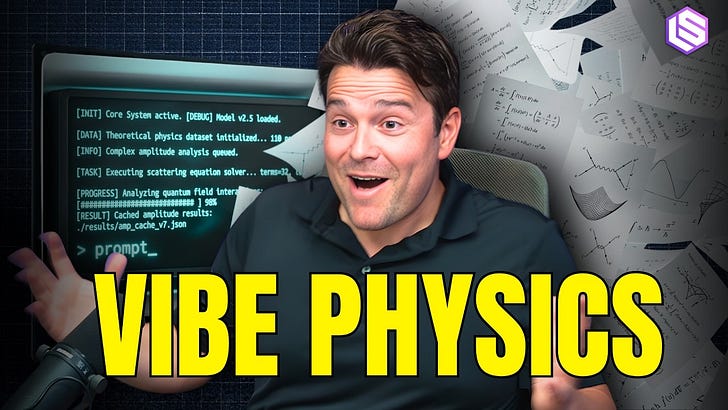

🔬Doing Vibe Physics — Alex Lupsasca, OpenAI
Latent Space: The AI Engineer Podcast
Theoretical physics is undergoing a paradigm shift as AI models demonstrate superhuman capabilities in resolving complex scientific problems. Alex Lupsasca, a professor at Vanderbilt and researcher at OpenAI, details how AI recently solved the "single minus gluon tree amplitude" problem—a challenge that had puzzled experts for over a year—by identifying a concise formula where human efforts yielded only unmanageable, factorial-growth expressions. Beyond mere computation, these models function as creative collaborators, allowing researchers to rapidly test hypotheses, navigate confusion, and explore multiple conceptual paths simultaneously. While human oversight remains essential for verifying results and formulating the right questions, the integration of AI into research workflows is accelerating discovery at an unprecedented rate. This evolution suggests a future where scientific knowledge is communicated through interactive, AI-augmented platforms rather than static, traditional academic papers.
00:00AI Emergence as a Superhuman Tool in Theoretical Physics Research
AI Emergence as a Superhuman Tool in Theoretical Physics Research
AI has transitioned from a simple productivity tool for email to a superhuman assistant capable of resolving complex theoretical physics problems. Recent developments, including the rapid simulation of the SYK model in quantum mechanics, demonstrate that AI can perform calculations in minutes that previously stumped experts for over a year. This shift marks a profound threshold in scientific research, where AI models are now integrated into the workflows of top-tier physicists to push the boundaries of the field.
06:40Fundamental Principles of Quantum Field Theory and Gluon Interactions
Fundamental Principles of Quantum Field Theory and Gluon Interactions
Quantum field theory reconciles the tension between the principle of relativity, which forbids information transmission faster than light, and the uncertainty principle of quantum mechanics. The framework relies on computing scattering amplitudes—complex functions that predict the probability of particle interactions. In particle colliders, these interactions involve gluons, the particles mediating the strong nuclear force that binds atomic nuclei. Understanding these amplitudes is essential for decoding the fundamental laws of nature, as they contain the complete information of a physical theory.
14:30Resolving Single Minus Gluon Tree Amplitudes Using AI Reasoning
Resolving Single Minus Gluon Tree Amplitudes Using AI Reasoning
The "Single Minus Gluon Tree Amplitudes" paper addresses a long-standing physics problem where specific interactions were previously thought to be zero. By identifying a loophole in collinear particle alignment, researchers discovered these amplitudes are non-zero and possess a simple structure. AI models, specifically GPT-5.2 Pro, were instrumental in simplifying a calculation that involved factorial growth—a "super-exponential" complexity—into a linear formula. This breakthrough allowed for a concise, elegant solution that had eluded human researchers for over a year, effectively mirroring the historical significance of the Park-Taylor formula.
37:00Extending Theoretical Breakthroughs to Quantum Gravity and Gravitons
Extending Theoretical Breakthroughs to Quantum Gravity and Gravitons
Following the success of the gluon research, the same methodology was applied to gravitons, the hypothetical quanta of gravity. Despite the increased mathematical complexity of spin-2 particles compared to spin-1 gluons, AI models successfully generalized the previous findings to gravity. This research was completed in weeks rather than years, demonstrating the power of AI to accelerate scientific discovery. The process involved using the gluon paper as a conceptual anchor, allowing the AI to navigate different mathematical formalisms and verify the results, which were then rigorously checked by human researchers.
53:00Redefining Physics Education and Research Workflows in the AI Era
Redefining Physics Education and Research Workflows in the AI Era
The integration of AI into physics research necessitates a reevaluation of how the next generation is trained. Traditional "rites of passage," such as performing arduous manual calculations, are being replaced by AI-assisted workflows. AI acts as a "scout" that explores multiple research paths simultaneously, reducing the time researchers spend in states of confusion. While AI excels at computation and technical execution, the core human skill remains the ability to identify the most fruitful questions to ask, effectively matching the right problem to the right tool.
1:16:00The Future of Scientific Communication and AI-Driven Discovery
The Future of Scientific Communication and AI-Driven Discovery
Static academic papers are becoming a bottleneck in scientific communication, as they often fail to capture the living, breathing process of research. Future scientific knowledge may exist as interactive, AI-integrated platforms where users can query the big picture or zoom into specific mathematical proofs. As AI models continue to scale, the focus of research will shift toward raising the bar for what constitutes a significant contribution. The ultimate goal is to move beyond solving known problems and leverage AI to make the creative leaps necessary to solve challenges that have stumped the physics community for decades.
Sign in to continue reading, translating and more.
Open full episode in Podwise